

New cabanas added to CocoCay

In:

A guest posted a brochure from a new cabana program that is set to launch on Royal Caribbean's private island of CocoCay that would be similar to the cabanas that are available on Labadee.

The cabanas on CocoCay come in two varieties: Bamboo Cabana and Caba-Nettes

Included in the Bamboo Cabana package:

· Island CocoLimo at your service for transport to Coco Cay locations
· Enjoy your made to order lunch created by your private chef
· 1 bottle of chilled Korbel champagne
· 4 x 1L bottles of Spring Water
· 2 floating mats and 2 snorkelling sets
· Beach towels
· Personalized Service
· Photo opportunity with professional photographer (one 6x8 photo included in pkg)
· Priority for Island Spa Appointments with 15% discount
· Fruit plate

$100 per single cabana $150 Family Cabana

Caba-Nettes include:

· Island CocoLimo at your service for transport to Coco Cay locations
· Enjoy your made to order lunch created by your private chef
· 2 x 1L bottles of Spring Water
· 1 floating mat
· Beach towels
· Personalized Service
· Photo opportunity with professional photographer (one 6x8 photo included in pkg)
· Priority for Island Spa Appointments with 15% discount
· Fruit plate

$35 per Caba-nette

It appears that like Labadee, these cabana options are available first to guests staying in a suite aboard their ship and any excess inventory is then offered to members of Royal Caribbean's Crown and Anchor society based on their seniority in the program.
Royal Caribbean explains why they picked British Columbia shipyards for Radiance of the Seas upgrades

In:

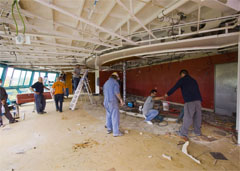
Royal Caribbean's Radiance of the Seas is undergoing upgrades and enhancements at Victoria Shipyards in British Columbia, Canada and will be ready to sail out on Thursday.  The choice Royal Caribbean made of these shipyards has a lot to do with the competitive options offered by Victoria Shipyards.

Royal Caribbean's vice-president of technical projects, Kevin Douglas, believes that Victoria Shipyards was the right choice to handle Radiance of the Seas' upgrades, "It’s not just an economic argument, it’s whether the shipyard has the capability to do all the work we need, is there the infrastructure around the shipyard.  We want to get in and out quickly.  On the West Coast of Canada and the U.S., this would be our choice, no question about it.".
In just three weeks, the shipyard will have Radiance of the Seas back into service to begin the Alaska cruise season.  Radiance is scheduled to leave Esquimalt Harbour on Thursday, bound for Vancouver to pick up passengers.

During it's time in the shipyards, 1700 workers have been working on upgrading, replacing and enhancing many aspects of Radiance of the Seas.  The ship's overhaul is meant to keep her a competitive option in a cruise market where the newer and bigger ships can cause customers to overlook the older ships in the fleet.

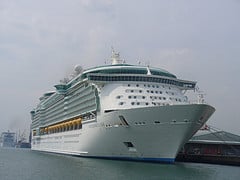
Independence of the Seas docks at the port of Alicante for first time

In:

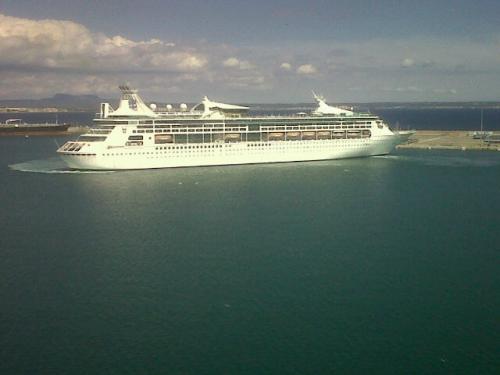
Royal Caribbean's Independence of the Seas, the largest cruise ships that sail the Mediterranean, for the first time has docked at the Port of Alicante from Palma de Mallorca before going back to England via Lisbon, according to reported in a statement the Port Authority of Alicante.

The arrival of Independence of the Seas to the Port of Alicante has had a special welcome event that fused traditional and new technologies. Specifically, an exhibition of traditional crafts of the province - pottery, white palm, rolls, cobblers and basket weaving teachers - combined with the use of the latest technology to interact with passengers.

The technological tools developed, a pioneer in the cruise industry, has allowed passengers Independence of the Seas the application instant download of Puerto de Alicante tourist for next generation mobile phones by scanning QR codes.

The chairman of the Port Authority of Alicante, Miguel Campoy, with this technology is available to cruise passengers "all available information regarding the cultural, culinary products and services in the province."

A QR Code (Quick Response Barcode) is a system for storing information in a two-dimensional bar code. Such codes, whose use is already widespread in countries like the U.S. or Japan, gradually replace the current barcode.

The recent inclusion of totally free software that reads QR codes in physical smartphones allows a wide range of new services aimed at tourists. Amenities generated by this new technological application highlights the ease of use by not having to manually enter data on the phones.

Thus, users with capture devices and programs can access content without typing a URL, or access through a browser.

Royal Caribbean to talk about Enterprise Social Networking at LA conference

In:

Royal Caribbean will be a featured speaker at  the Social Networking Conference and Strategic Communications Conference taking place on June 23-24, 2011 at the SLS Hotel in Beverly Hills, California.

Royal Caribbean's Global Corporate Communications Manager, Cynthia Martinez, will be on hand at the conference to cover the topic of crisis management with social media.  Martinez will use the example of the earthquake in Haiti and the aftermath to discuss how Royal Caribbean leveraged their website, blog, Facebook, and Twitter to keep the media and general public informed.  
She will discuss how these social media tools helped mitigate some of the negative press Royal Caribbean received and how they helped prevent long-term damage to the cruise's brand.


Royal Caribbean employees give back to local community

In:

A number of Royal Caribbean employees in the Eugene, Oregon area decided to give back to their local community when about 60 Royal Caribbean employees teamed up with St. Vincent de Paul to clean up some affordable housing complexes.

The group split up into teams and landscaped as well as painted three different sites in the Eugene area.

The effort was part of Royal Caribbean's annual corporate volunteer day that's goal is to help the community around them.

Royal Caribbean has a a 200000-square-foot national customer service center in the Eugene-Springfield, Oregon area that opened in 2005.

Eyewitness report of Gibraltar explosion from Independence of the Seas

In:

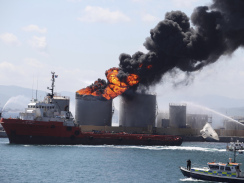
Earlier this week an oil tank exploded right next to Royal Caribbean's Independence of the Seas.  One of the passengers aboard Independence of the Seas shared this first-hand report with The Telegraph.

We were in our cabin when we heard a loud bang. At first we presumed it was the anchor – the ship was due to leave the port at Gibraltar, so we thought it was setting sail a little earlier than scheduled.

Within minutes, the captain made an announcement, ordering everyone off the open decks and balconies, and sending a rapid response team up to deck 11 where the outdoor pools and bars were packed with young families making the most of the Gibraltar heat.

Just four minutes later, we slipped our moorings and the ship sailed, leaving the gangway and two passengers behind. Within minutes, the captain said it was safe to return to the open decks.

At dinner that night, the explosion was on everyone’s lips. “We thought it was a bomb,” one middle-aged passenger said. “American ship in a British port – quite an easy target.” 

Hurricanes: Don't worry!

In:

Hurricane season in the Atlantic began this week and every year cruise passengers worry about how a hurricane could impact their cruise.  While there's the possibility that your itinerary may change, Royal Caribbean head Captain Bill Wright urges passengers not to worry.

"Keep in mind that hurricanes or storms are travelling at about six to 12 knots and today's modern ship cruises over 20 knots," he says.

"In a worst-case scenario, we can outrun the storm, although we very rarely have to do that. As soon as we see a storm could affect our routing or home port, we move into the situation room with the president and all the teams, as do all the major cruise lines.

"Here we determine whether we may have to skip a port, continue as usual or exchange a Western Caribbean cruise for an Eastern Caribbean cruise. Once this happens, it gets to be a bit of competition among the lines to see who can set up the new schedule the fastest, ensuring the best berth in the new ports."

Those are for en-route ports, but what happens if a hurricane's heading to your home port? Wright explains: "This probably is the most difficult time, as we have to worry about all passengers on the ship, plus those waiting for the ship. For example, if Fort Lauderdale is our base, we may have to move to Port Canaveral or stay an extra day at sea, necessitating a massive re-deployment of our passengers."

What about rough seas on the edge of the storms?

"Today's ships are computerstabilized, making us able to cope much better than we could some years ago," he says.

"The technology really showed us what it could do when we were ferrying Oasis of the Seas across the Atlantic with just crew and workers on board finishing the interior. We hit some major weather but (everyone) kept working through the storm."

Subscribe to